PR Cycle Time Threshold Filter
Last updated: May 27, 2026
Overview
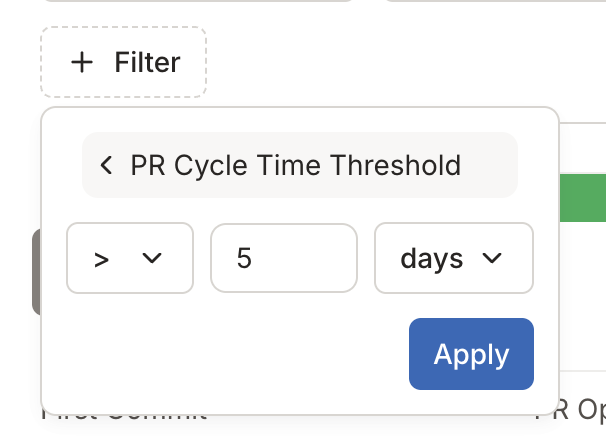
The Cycle Time Threshold filter lets you narrow your PR data to a specific subset based on how long PRs take from first commit to merge. Use it to focus on outliers that are slowing your team down, or to exclude extreme values and study the typical bulk of your work.
Where to Find It
The Cycle Time Threshold filter is available in the PR Lifecycle report, displayed alongside all other PR filters in the filter row at the top of the report.
It follows the same persistence behavior as every other filter on that page: your selection is saved automatically and restored when you return to the report.
How It Works
The filter operates on total PR cycle time — the elapsed time from the first commit on a branch until the PR is merged.
When active, the filter limits all charts, metrics, and tables in the report to only the PRs that satisfy the condition you set.
Filter controls
The filter UI contains three fields:
Control | Options | Description |
|---|---|---|
Operator |
| Whether to keep PRs above or below your threshold |
Value | Any positive number | The numeric threshold |
Unit |
| The time unit for your threshold value |
The default state when first opening the filter is > 5 days.
Press Apply (or hit Enter in the value field) to activate the filter. Press Cancel to discard your changes.
Use Cases
Focus on slow PRs — use >
Set the operator to > to include only PRs whose total cycle time exceeds your threshold. This is useful when you want to:
Identify which teams, authors, or repositories are responsible for the longest-running PRs.
Investigate what distinguishes a PR that took 10+ days from the rest.
Spot bottlenecks in a specific stage (e.g., time waiting for review) that correlate with overall long cycle times.
Example: > 7 days — shows only PRs that took more than a week from first commit to merge.
Exclude outliers — use <
Set the operator to < to include only PRs whose total cycle time is below your threshold. This is useful when you want to:
Remove large infrastructure PRs or seasonal anomalies from your averages.
Understand the "steady-state" velocity of a team without extreme outliers skewing the data.
Compare metrics before and after a process change without distortion from long-running legacy PRs.
Example: < 3 days — shows only PRs that merged within 3 days, focusing on the fast-moving work.
Active Filter Display
When the filter is active, it appears as a removable chip in the filter row, displaying the condition in plain language — for example:
> 5 days< 24 hours> 1 day
Click the × on the chip to remove the filter and return to seeing all PRs.
Notes
The filter accepts positive values only. Zero and negative values are ignored.
Only one threshold can be active at a time (the filter does not support combining a lower and upper bound simultaneously).
The filter is off by default and does not affect the report until you explicitly apply a value.
The filter applies to total cycle time (first commit → merged) specifically — it does not filter on individual lifecycle stage durations such as time in review or rework time.
The filter works on merged PRs only, consistent with the PR Lifecycle report's scope.